Author: Dante
content
- Purgatorio - Canto 1, 3, 5, 6 - Ante-Purgatory
- Purgatorio - Canto 2 - Dante’s self-reference
- Purgatorio - Canto 9 - Entering Purgatory
- Purgatorio - Canto 10, 11 - Pride
- Purgatorio - Canto 16 - Wrathful, free will
- Purgatorio - Canto 17 - Love and sin
terms and themes
- Poetry, literature
- Art
- Contrapasso
- All sins arise from love
repentance
Repeated elements on each terrace, communicated differently on each terrace:
- Contrapasso
- Reinforcement of opposite virtue
- Communal prayer appropriate to circumstances
- Three steps and ritual of penance
- Contritio cordis (contrition of the heart)
- Confessio oris (confession of the lips)
- Satisfactio operis (satisfaction by works)
- Also
- Past, present, future
- Innocence, sin, redemption
- Manner of purgation on each terrace
- Spending time on each in proportion to degree of sin
background
- Embracing larger political reasons
- Tone and subject changes from Inferno
- To adapt to spiritual climate of Purgatorio
- By the time he writes it, he has left exile several years behind
- Exists on Earth
- Garden of Eden at top of mountain
- Concentric circles of the skies
- The laurel crown is a canonical attribute for poets since 15th century
- Laureate
- Name from latin
- Purgare, purgatorius
- Punishments inspired by logic of purging and separation from sin
- Angels as guardians
- Erase one of the seven “P”s from Dante’s head
- At end of each terrace
- Erase one of the seven “P”s from Dante’s head
- Set architecture
- One sin per terrace
- As Dante evolves in Inferno, the relationship between him and Virgil evolves
- Faltering when facing Christian demons as opposed to mythological beasts/characters
- Entrance at city of Dis
- Need divine messenger to intervene
- Inferno - Cantos 19, 21, 22 - Fraud in Malebolge, simonists and grafters
- Entrance at city of Dis
- Faltering when facing Christian demons as opposed to mythological beasts/characters
- No specific reference to a place called Purgatory in the Bible
- Early Christianity, Middle Ages
- Biblical support: images of purging fire and offering prayers for those who died in God’s grace
- Part of official Church doctrine in 1274
- Major point of doctrinal disagreement
- At beginning of Purgatory, emphasis on more elevated style
- Less description of concrete scenes
- More extensive set-up
- Only recently popular before he published the canticle
- Approval in Christian dogma
- Less sources describing transient second realm compared to richness of classical sources describing Inferno
- Only recently popular before he published the canticle
- Purgatory will eventually cease to exist
- All souls to Paradiso
- Souls in Purgatory have all repented
- In addition to time spent on terraces, those in Ante-Purgatory must wait an additional amount of time depending on the degree of their sins before entering Purgatory proper
analysis
- Preparation for Virgil’s departure
- Celebration of Virgil as a poet
- Influence
- Literary
- Moral
- Influence
- Celebration of Virgil as a poet
- Political and moral freedom
- Comparison of Cato to Minos
depiction of purgatory
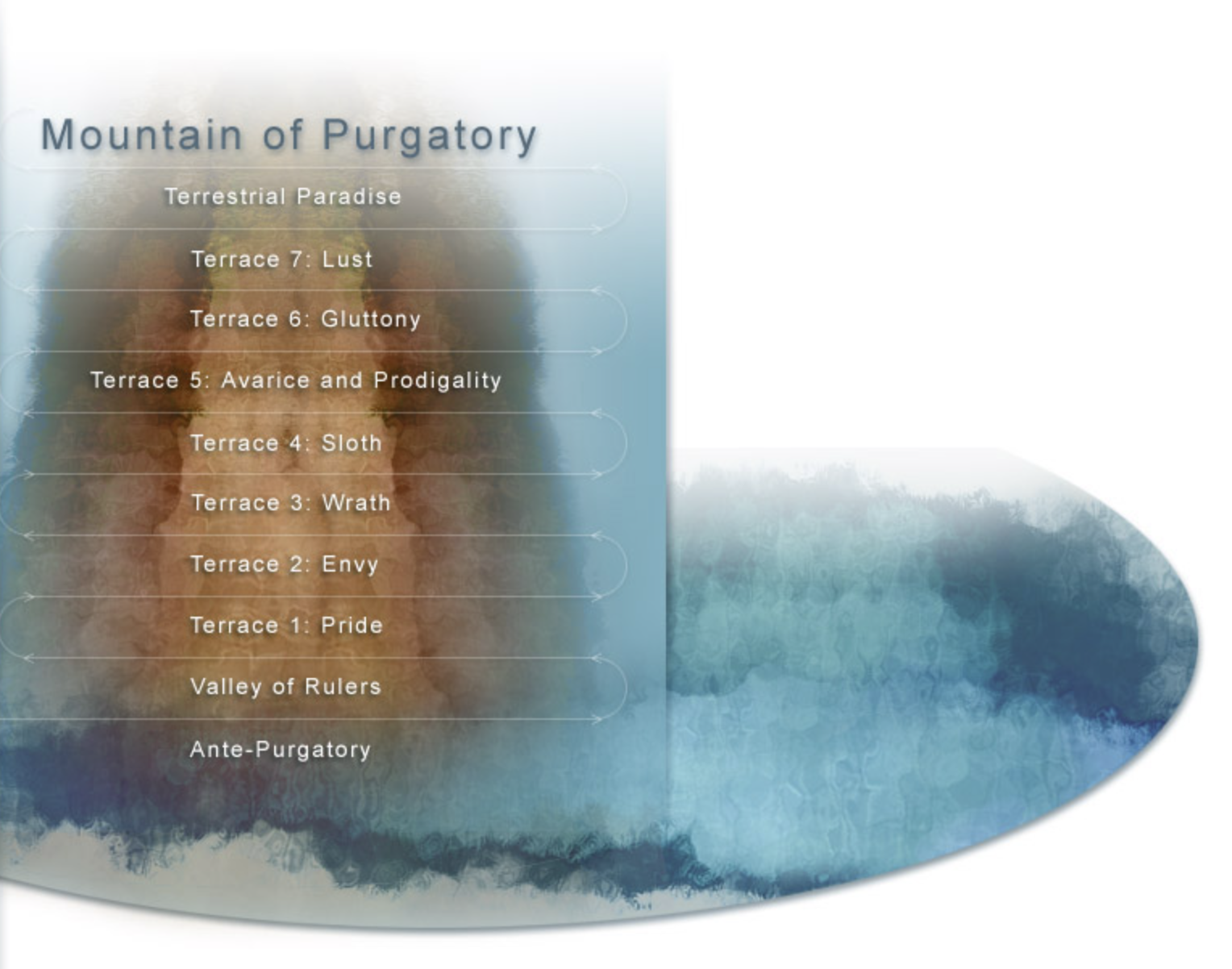
- Seven capital sins (Seven deadly sins)
- More original because less sources on Purgatory
- More recent Christian dogma
- Less structured than Inferno
- Anti-Purgatory
- Valley before gates
- Four groups of souls
- Excommunicated
- Thirty times as long as lived in excommunication
- Lazy spirits who waited until the last minute to repent and embrace God
- Those killed in a violent way so only had time to repent at the very last minute
- Negligent rulers who later repented
- Excommunicated
- Seventh layer is lust
- Two types of lust
- Heterosexual
- Sodomites (classified as violence in Inferno; divine design for justice, as there is no place for violence in Purgatory)
- Two types of lust
- Specific length of time in ante-Purgatory
- Prescribed amounts of time on different terraces in proportion to impulse to sin
- Projects self among souls in Purgatory
- Accepted salvation offered in Inferno - Canto 1 - Dark woods by Virgil and three blessed women
- Opposite construction to Inferno: most serious to least serious sin
- Pride → envy, wrath, sloth, avaricious, gluttonous, lust