The dopamine curve
context
I've always thought myself to be plenty disciplined. However, recently I've been having a tough time pushing myself to do hard things.
If you know me, you know that I keep my social media apps under a time lock. But last weekend, I thought that, since I had built such discipline, surely it wouldn't hurt to remove the restrictions for a bit for more easy access to messaging and friends. Cue the "famous last words" meme. I immediately went on a three hour (or probably more) doom-scrolling binge through an ungodly mix of brain rot, educational content, and political news right before bed on Sunday.
The next morning, the effects were immediate. I felt lethargic, depressed, and anxious, and could barely drag myself out of bed to go to work. I had an inkling that my Instagram reels binge was the culprit, so I deleted the app from my phone altogether.
learnings
This morning, I stumbled across Newel of Knowledge's video, "how to make doing hard things easier than scrolling youtube" (How did the algorithm read my mind? That's kind of freaky).
The creator, Lewis, immediately got me with his first point: "A depleted brain will always default to ease".
With a big dopamine hit comes a big crash as the brain tries to maintain hormonal equilibrium.
Thus, if I scroll on social media first thing in the morning — or even the night before — my motivation is completely depleted for the day, and even simple tasks will seem gargantuan.
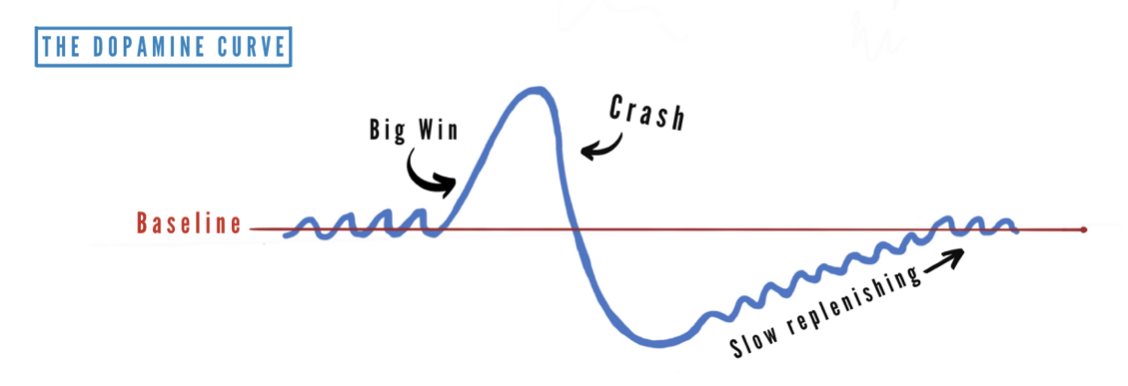
Dopamine detoxing is a buzzword that's thrown around a lot on social media. People who mention it seldom explain the principle behind it, so it has lost its meaning for me until now. I'm sure I've heard the explanation before, but this refresher hit me at just the right time.
So how should we combat this when social media today profits off of our attention and addiction?
Lewis presents the following points:
- A depleted brain will always default to ease
- Reappraise discomfort
- Win the evening
- Structure your day right
- Identity without evidence is just fragile consistency
- Never miss twice
- When intimidated, break it down to 5%
- Mesmerize yourself into ritual
- Never set a pace you can't keep
- The effort is the reward (the discipline paradox)
- Self-negotiation prevents self-termination
Watch the video for details, but here is what stood out to me most:
- To be motivated to do hard things, avoid crashing and burning by being mindful of when you pursue easy dopamine hits (also, an aside on my beef with the overuse of the term "mindful")
- Don't deprive yourself completely — instead, be selective about what you allow to monopolize your energy and motivation
- "Your tomorrow is created from today, and the order that you give your evenings is the strength that you feel in the mornings"
- Consistency is more important than perfection and immediate results
- When you don't want to do something, aim to do the bare minimum rather than skipping it altogether
- Don't focus on just doing the hard thing, focus on becoming the type of person who does the hard thing by giving your brain evidence that you are that person
- Instead of defeating your "inner bitch," negotiate with it and compromise (e.g. I need to do this thing, but part of me wants to scroll on social media → why? → I don't want to do this thing because it's hard and boring → play music while working to satisfy both desires)
takeaways
We can't force ourselves to do hard things. Motivation comes from how we design our environment, habits, and life.
actions
Going forward, I will
- Be stricter with myself about spending my evenings after 9pm more mindfully
- Peruse social media and YouTube with intention rather than allowing junk information to monopolize my wellbeing and happiness
- Focus more heavily on Learning through synthesis and actually articulating my thoughts here
- Choosing reading and learning over doom scrolling