Mahabharata
review
This is a work in progress. The book is so long that I feel like I would have a pretty bad time if I waited til the end to write the review.
overview
- Transmits life experiences without being didactic; generational wisdom
context
Social class is majorly influential in the Mahabharata. Differences in life circumstances lead to wildly different paths, whether fated or of one's own volition. The Indian caste system used at the time was organized as follows:
- Brahmana: priests and teachers
- Kshatriya: kings, rulers, and warriors
- Vaishya: merchants, craftsmen, landowners, and skilled workers
- Shudra: farm workers, unskilled workers, and servants
- Dalit (untouchable): outcastes and those who handle human and/or animal waste
Most of the main cast consists of kshatriya; those who are not are discriminated against. Karna is our most prominent example of this. Though he is, by blood, the son of Kunti and Surya, due to his adoptive parents' social standing, he is considered a sūta, a mixed caste. Thus, despite his prowess at archery, his low social class causes Draupadi to reject him as a suitor at her svayamvara, choosing Arjuna instead.
- Story is passed through different hands
- Oral tradition
- Captures culture
- Community story
The poem was a map of the labyrinth,
the moral maze, that is our life on earth.
It told of choices and of mortal error,
of how even the saintly go astray
while, even in the worst, glimmers of gold
reveal themselves to a compassionate eye. (89)
Yet, the tradition of adding commentary to manuscripts sometimes leads to interpolation issues where annotations or additions are mistaken as part of the original work. (Medieval Commentary and the Interactivity of Text)
core themes
good and evil
- Yudhishthira vs. Dhritarastra
- Blurring lines
- What makes someone good? Often shaped by life circumstance
- the Mahabharata's free will discourse
writing style
Carole Satyamurti's version of the Mahabharata is a retelling, meaning it is not a direct translation, but rather a paraphrase. Shlokas (with 16 syllables per line) become blank verse. Satyamurti chooses to emphasize certain events through her own interpretation, but she maintains each characters perspective and philosophy. Though I have not seen the original, I quite like the style, as the pace and cadence of the verse is captivating, especially in fight scenes and descriptive imagery. For instance, take the following lines describing the atmosphere before a monsoon:
The air was still and heavy
with expectation, earth begging for rain
as though the whole of life were in suspense. (332)
Or this depiction of Krishna:
Dark-skinned Krishna,
swathed in a robe of yellow silk, resembled
a sapphire in a setting of bright gold. (755)
On the integrity of translation, the afterword notes:
A text that represents another text may be a translation (“faithful”), an adaptation (somewhat “loose”), a retelling (relatively “free”), or even a reworking (“creative”). In the past two decades, literary theorists have argued persuasively that all these categories can be placed on a single conceptual gradient called “translation” in the broadest sense, which moves from the most literal rendering of a text at one end to the most approximate at the other. In the late seventeenth century, John Dryden suggested brilliantly that the three defining positions on this spectrum be labeled “metaphrase,” which is a word-for-word or interlinear version; “paraphrase,” which deviates from the letter of a text, but not its spirit; and “imitation,” which ignores the letter, and also merely “strives after” its spirit. In general, translators may pursue any of these shades of rendering legitimately, provided they identify the genre of their output without ambiguity—that is, as a translation, a paraphrase, an adaptation, an imitation, and so on.
The narrative itself consists of layers of interwoven stories. First, the prologue creates a frame—Vyasa, supposed author of the work's, son, Vaishampayana tells the story to the king Janamejaya. Occasionally, they act as a surrogate audience, asking questions about the story and facilitating transitions. Within the legend itself, side characters introduce embedded stories, too. Notably, when these tales that are three layers deep are told, the writing style switches from blank verse to prose. See also: On the frame narrative in The Burning of the Khandava Forest.
who's it for + difficulty
- This version makes the Mahabharata accessible for a wider audience
- Older translations may be more difficult to read due to archaic voice
- This is paraphrased for modern audiences and the vocabulary used is simple yet beautiful
- Entertaining and humorous at times
- Anyone who wants to broaden their horizons
- European antiquity is so often romanticized, while Asian, especially West and South Asian, culture is often ignored or downplayed.
- However, upon reading the Mahabharata, you'll find that the culture and stories are just as rich, if not even richer.
- Learn about Hindu gods, mythology, and cosmology
what gave me the fizz
connections
- The Odyssey: Odysseus's return, Penelope's virtue and devotion
questions
thoughts & analysis
- The Mahabharata is a story of pride and humility
- On the frame narrative in The Burning of the Khandava Forest
- Epic poetry reflects the divinity within the human psyche
- the Mahabharata's free will discourse
- 20% in: reading this feels like somebody spiked my drink without me knowing and I'm realizing too late that I'm high
notes
- I think this is a great retelling because the pace and cadence of the verse is captivating, especially when it comes to fight scenes
- Paraphrased from translation, transforms shloka (16 syllables per line) into blank verse
- Chosen emphasis on events, but maintains character perspectives
- Very insightful and interesting Goodreads review
- Some of these stories are high key funny as hell
Part I: The Book of the Beginning
The origins of the Bharatas and the rift between the Pandavas and Kauravas. The Pandavas are sent into exile, but they come back with their beautiful wife, Draupadi, and are granted half the kingdom even though Durodhyana wants nothing more than to smite them. Karna joins the Kauravas because he is envious of Arjuna. Though he is just as talented, he is denied many things in life due to his lowborn status.
- Satyavati: daughter of a fisherman or royal seer
- Parashara: great sage, rapist
- Vyasa: son, became grown instantly
- Parashara: great sage, rapist
- Vasus: eight celestial beings cursed to be born mortal
- Wanted Ganga to bear them and drown them in a river to release from the hardships of a mortal life
- Bharatas: lived in Hastinapura
- Shantanu: leader
- Ganga: river goddess, wife
- Had known each other in a prior existence
- Devavrata: last and only son that was not killed; celibate so Shantanu could marry Satyavati → renamed Bhishma
- Marries Satyavati after Ganga leaves
- Vichitravirya: son, king
- Amba: after getting kidnapped, refuses to marry him, instead marrying King Shalva
- Ambika: wife
- Ambalika: wife
- Chitrangada: son, became king first, then died
- Vichitravirya: son, king
- Ganga: river goddess, wife
- Shantanu: leader
- Satyavati wants Vyasa to father the widows' children since Bhishma will not break his vows
- Vyasa is dirty and stinky
- Dhritarashtra: blind son of Vyasa and Ambika
- Ghandari: daughter of King Subala, wife
- Duryodhana: large, muscular first-born son
- Kauravas: hundred sturdy sons
- Kauravas being born from jars is similar to confinement of cursed spirits in Jujutsu Kaisen
- Yuyutsu: son with lowborn woman
- Ghandari: daughter of King Subala, wife
- Pandu: pale son of Vyasa and Ambalika
- Kunti: Yadava princess, wife
- Yudhishthira: child with Dharma
- Bhima: child with wind god Vayu
- Arjuna: child with Indra
- Madri: daughter of Madra King, wife
- Nakula and Sahadeva: child with twin deities, Ashvins
- Kills herself after Pandu dies to a curse of death the moment he is overtaken with passion
- Pandavas
- Kunti: Yadava princess, wife
- Vidura: wise son of Vyasa and maidservant
- Sharadvat: worthy sage's son, brahmin with mastery in weaponry
- (Spontaneous ejaculation) Spontaneously ejaculates onto a reed after seeing a beautiful asparas
- Kripa: gifted fighter
- Kripi: sister
- Drona: husband, brahmin expert in weapons and astras
- (Spontaneous ejaculation) His father had spontaneously ejaculated after seeing an asparas and kept the seed in a jar, hence his name
- Drona: husband, brahmin expert in weapons and astras
- (Spontaneous ejaculation) Spontaneously ejaculates onto a reed after seeing a beautiful asparas
- Karna: sees Arjuna as his rival
- Son of a driver, Adhirtatha, and Radha
- Found him on the Ganga
- {Folktale motif of the exposed child, cf. Oedipus Rex, Romulus and Remus}
- Named Vasusena, "armed with riches"
- Secret son of Kunti and Surya
- Found him on the Ganga
- Installed as king of Anga by Duryodhana so he can challenge Arjuna
- Son of a driver, Adhirtatha, and Radha
- Ekalavya: nishada, forest tribal, who is better at archery than Arjuna, so Drona makes him cut his thumb off, yet he keeps practicing
- (Devotion to a cause)
- Drona takes the Pandavas to conquer Drupada's land
- Drona has beef with Drupada because they were besties as children, but once Drupada became a king he looked down on Drona
- Drupada prays for a son to kill Drona and a daughter to become Arjuna's wife
- Dhrishtadyumna: son
- Krishnaa (Draupadi): daughter
- Marries all five Pandavas because Arjuna wins her love at her svayamvara, but when the brothers come home with her, Kunti was like "y'all have to share whatever you got today"—by all marrying her, then their mother won't be a liar
- {The Pandava's return to society (though recognized in the moment by Krishna and Balarma only) reminds me of Odysseus, still dressed as a beggar, stringing and shooting the arrow through twelve axes to "win" Penelope's hand}
- Marries all five Pandavas because Arjuna wins her love at her svayamvara, but when the brothers come home with her, Kunti was like "y'all have to share whatever you got today"—by all marrying her, then their mother won't be a liar
- Duryodhana asks Dhritarashtra to send the Pandavas into exile and secretly plots to burn them down in a lacquer house
- Pandavas fake their deaths
- In the forest, an ogre, Hidimbaa, falls in love with Bhima
- Bhima kills her brother, Hidimba
- She wants to marry Bhima, so Yudhishthira is like "aight bet but bring him back every day by sunset"
- "Now Hidimbaa, summoning her supernatural powers, took Bhima off on blissful honeymoons to secret places where time stopped for them in their exquisite lovemaking" and they have a kid, Ghatotkacha
- In the forest, an ogre, Hidimbaa, falls in love with Bhima
- Pandavas fake their deaths
- Krishna and Balarma: Kunti's brother's son; the Pandava's cousins
- Yadavas
- To teach Indra "a lesson for [his] overweening pride", Shiva traps Indra in a cave with four other Indras
- To be set free, they would have to be born in the mortal world
- They ask if they can have gods as fathers, at least
- → Pandavas
- Shri, goddess of royal fortune, would be their shared wife as Draupadi
- With this explanation, Drupada allows the five way marriage
- Duryodhana wants to fight the Pandavas with a surprise attack
- Dhritarashtra says Bhishma, Vidura, and the council must support it because he must remain neutral
- Instead, Yudhishthira gets half the kingdom, the Khandavaprastha
- Khandava tract is barren
- Khandavaprastha → Indraprastha
- Narada: great and subtle seer
- Cautionary tale against brothers fighting over woman
- They vow to go into a celibate exile if they ever see each other sleeping with Draupadi
- This happens to Arjuna when he needs to fetch his bow from the quarters where Yudhishthira and Draupadi are hanging out to save a brahmin from thieves
- He bangs three women because technically he only has to be celibate relating to Draupadi
- Ulupi: snake princess
- Basically says "I will die if you do not quench my thirst for you"
- Chitrangadaa
- Stays for three months and gives her a son
- Subhadra: Krishna's sister
- Forcefully takes her as bride
- Draupadi is salty as hell
- Abhimanyu: son with Arjuna
- Ulupi: snake princess
- He bangs three women because technically he only has to be celibate relating to Draupadi
- This happens to Arjuna when he needs to fetch his bow from the quarters where Yudhishthira and Draupadi are hanging out to save a brahmin from thieves
- Draupadi has a son with each Pandava in five years
- Arjuna and Krishna fight the gods to allow Agni to consume the Khandava forest
- Varuna: keeper of weapons
- Arjuna
- Gandiva bow
- Two self-replenishing quivers
- Krishna
- Discus that always returns
- Great club
- Vishvakarman: celestial craftsman
- Horse-drawn chariot with image of divine monkey
- Arjuna
- Varuna: keeper of weapons
- The listener and storyteller interject to transition to side stories and keep the audience involved by mirroring their inner questions
Part II: The Book of the Assembly Hall
Maya builds the Pandavas a beautiful assembly hall. Durodhyana visits and is jealous, so he devises a plan to invite Yudhishthira to gamble his kingdom away. Draupadi is dishonored, yet nobody is able to speak up for her in the moment. Dhitarashtra finally returns everything to Yudhishthira because the Kauravas have taken it too far. However, Durodhyana persuades him to call them back to gamble for thirteen years in exile. They must live the final year among society, and if they are discovered, the thirteen years must repeat until they succeed.
- Maya, a demon Arjuna spares during the Khandava forest fire, builds Yudhishthira a great assembly hall
- Narada comes back and tells Yudhishthira he has to do the rajasuya sacrifice so Pandu can enter Indra's realm of light
- To gain allies, Krishna says the Pandavas must defeat Jarasandha of Magadha
- Bhima rips him in half
- They free 86 kshatriya princes and gain their allegiance
- Yudhishthira does the rajasuya sacrifice and becomes king of kings
- Vyasa tells him that after thirteen years of suffering, there will be a great war
- Krishna: embodiment of Narayana, the self-created
- Arjuna: embodiment of Nara, the eternal seer
- Durodhyana is so jealous that he tells Dhitarashtra he will kill himself if Dhitarashtra doesn't invite Yudhishthira to gamble his kingdom away
- (Honor) Shakuni cheats on behalf of Durodhyana
- Yudhishthira becomes a gambling gambler
- "Until the dreadful day when the passion for gambling possessed you, no one was more virtuous than you, Yudhishthira" (493)
- (Honor) Draupadi is dishonored and nobody speaks up for her
- Finally, Dhitarashtra returns everything to Yudhishthira because the Kauravas—Durodhyana and Duhshasana—have taken it too far
- Durodhyana persuades him to call them back and gamble for thirteen years in exile; they would have to pass the final year in society, unrecognized
Part III: The Book of the Forest
The Pandavas spend their first twelve years of exile in the forest. During this time, Arjuna goes to the Himalayas to obtain astras from Shiva, Yama, Varuna, Kubera, and Indra. The Kauravas prepare for the inevitable battle to come.
- Yudhishthira prays to Surya to feed his companions
- Durodhyana and Dhitarashtra are shitting their pants at home because they know they messed up
-
- "In Hinduism, Maitreya is prophesied to be the king of Shambala, which is also the birthplace of the Kalki Avatar"
- In Buddhism, he is thought to be a future Buddha to come when the teachings of Gautama Buddha have degraded
- (Dharma, fate) Yudhishthira, Draupadi, and Bhima argue about dharma and free will
- (Devotion) "I choose to follow dharma, and I do it because it is right, not to obtain rewards" (494)
- Arjuna goes to the Himalayas to obtain Shiva's weapon, Pashupata, the ultimate destroyer
- Yama, Varuna, and Kubera give Arjuna weapons, too
- Yama: god of death
- Varuna: god of the ocean
- Kubera: lord of treasures
- Indra takes him to his kingdom, Amaravati
- Gives his sacred weapon, the thunderbolt
- Yama, Varuna, and Kubera give Arjuna weapons, too
- Chitrasena: music teacher and gandharva king
- Indra asks Arjuna to make war against Nivatakavacha demons
- The Pandavas go on a pilgrimage
- Lomasha tells stories
- Rishyahsringa is also born by spontaneous ejaculation when his father sees an asparas; a doe swallows the seed and the boy with a horn is born
- Yvanashva accidentally drinks the purified water that was meant for his wife to bear a child. Because he drank it, his son is born after his side splits open. The child, Mandhatri, becomes an accomplished archer.
- "Bhima had a brainwave" and calls the son, Ghatotkacha, he had with the rakshasa Hidimbaa to carry everyone up to the mountain where Arjuna is
- Bhima meets Hanuman in the forest
- "Tell me the tale of...", "What happened when..."
- Nested frame narration, multi-layered stories (three)
- Two-times nested stories become prose, contrasting with verse format
- Dialogue and philosophy interspersed into stories
- e.g. in between episodes, they ask rishis and brahmans for advice, or when Draupadi/Yudhishthira/Krishna explains their actions and philosophies to others
- Manu and fish, flood mirrors Noah's ark story
- Chronicling history beyond the human lifespan, far removed
- Chapter 23, Markandeya tells the Hindu creation myth (cf. Genesis, Theogony)
- Falling from virtue to sin
- Cycle of ages
- Krita age: humans mingle with gods
- Treta age: virtue diminished by a quarter
- Dvapara age: vice and virtue mixed half and half
- Kali age: where evil stalks the earth
- Markandeya's story of meeting Narayana in child form → absolute trust in Krishna
- Draupadi and Satyabhama (Krishna's wife) have a conversation about being a good wife
- Reveals role of women and cultural norms
- Bhima has names/modifiers like bull-like and wolf-belly, similar to The Iliad, "brilliant Hektor", "godlike Sarpedon"
- Do the other characters? I didn't really notice.
- Duryodhana tries to flex on the Pandavas but gets captured by ghandaras and saved by Arjuna instead
- He wants to kill himself but the demons are like "no pookie we need you we've possessed everyone to be on your side"
- Karna swears not to wash his feet until he defeats Arjuna
- Jayadratha kidnaps Draupadi
- The Pandava's want to kill him, but because he is Dhritarastra's daugher, Duhshala's, husband, they instead beat him and shave his head so that only five tufts are left
- Story of Savitri winning back her husband's life walking with Yama and answering his questions
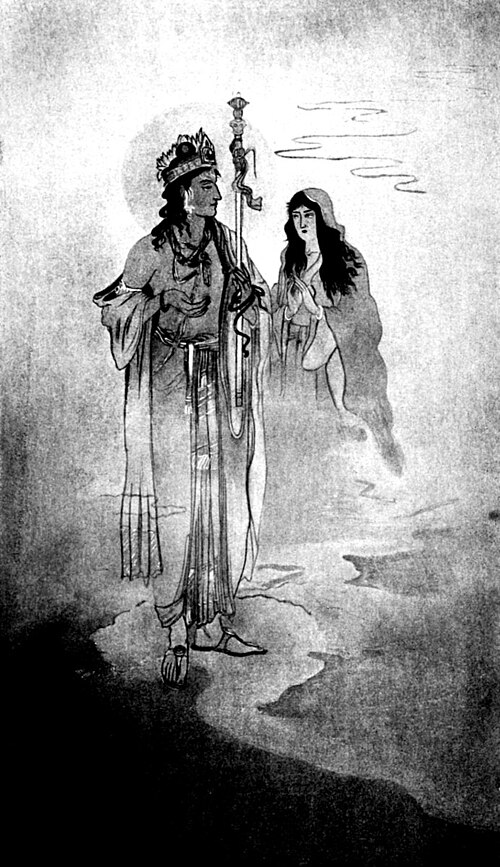
- Similarly, Draupadi sustains the Pandavas through her virtue
- Women's role: suffering to keep men on a virtuous path? Martyr figure? Great Mother, bearer of all burdens? Why does the role of rescue through love and virtue fall on women? Reflection of purity culture?
- Penelope waiting for Odysseus
- Women's role: suffering to keep men on a virtuous path? Martyr figure? Great Mother, bearer of all burdens? Why does the role of rescue through love and virtue fall on women? Reflection of purity culture?
- Similarly, Draupadi sustains the Pandavas through her virtue
- Surya warns Karna that Indra is coming to take his armor
- Karna would rather die than be dishonored, so he cuts it off himself but asks for a celestial weapon, Indra's javelin
- The Pandavas drink from a pond and die
- Yudhistira answers a yaksha's questions—the yaksha turns out to be Dharma, who is delighted by all his answers and brings all the brothers back to life
- Also promises that the Pandavas will not be recognized in their last year
- Yudhistira answers a yaksha's questions—the yaksha turns out to be Dharma, who is delighted by all his answers and brings all the brothers back to life
Part IV: The Book of Virata
In their thirteenth year of exile, the Pandavas live in a court under disguises. They are blessed by Dharma to not be discovered. During a cattle raid, Arjuna defeats the Kaurava forces as the dancer with prince Uttara as his charioteer. The Kauravas retreat. Virata's daughter, Uttaraa, marries Abhimanyu.
- Thirteenth year of exile, disguises
- Yudhisthira: brahmin Kanka
- Bhima: cook Ballava
- Arjuna: eunuch, transvestite Brihannada
- Was Indian culture accepting of transgender people?
- Nakula: stablemaster Granthika
- Sahadeva: cattle station manager Tantipala
- Draupadi: maid Sairandhri
- Kichaka assaults Draupadi
- She asks Bhima to kill him, then says it was the revenge of her ghandara husbands
- The court thinks she is too dangerous and wants to kick her out
- She asks for 13 more days, which marks the end of their final year in exile
- Because Kichaka is dead, the Kauravas embark on a cattle raid
- The court thinks she is too dangerous and wants to kick her out
- She asks Bhima to kill him, then says it was the revenge of her ghandara husbands
Part V: The Book of Perseverance
- Arjuna defeats the Kauravas in disguise with prince Uttara as his charioteer
- Duryodhana fights him
- Insults hurt his ego
- Duryodhana fights him
- Princess Uttaraa marries Abhimanyu
locations
- Kurukshetra: plain
- Yamuna: river
- Hastinapura: city on river Ganga, City of the Elephant, home of the Bharatas
- Panchala: Drupada's kingdom
- Kampliya: capitol
- Dvarka: Krishna's land
- Indraprastha (Khandavaprastha): Yudhishthira's land
terms
- Rishis: enlightened ones
- Ashram: a spiritual hermitage or a monastery
- Asparas: nymph or fairy
- Astra: godly weapon
- Rakshasa: "a race of usually malevolent beings prominently featured in Hinduism, Buddhism, Jainism and Folk Islam. They reside on Earth but possess supernatural powers, which they usually use for evil acts such as disrupting Vedic sacrifices or eating humans."
- Svayamvara: "matrimonial tradition in ancient Indian society where a bride, usually from Kṣatriya caste, selects her husband from a group of assembled suitors either by her own choice or a public contest between her suitors"
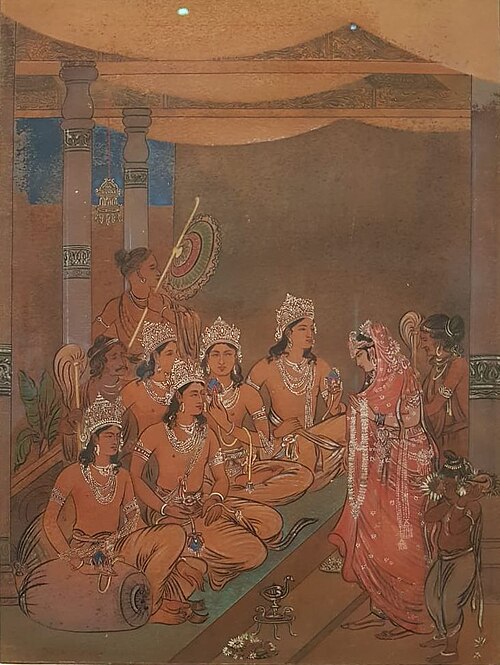
Marriage of Nala Damayanti by Nandalal Bose (1882–1966)
- Indian caste system
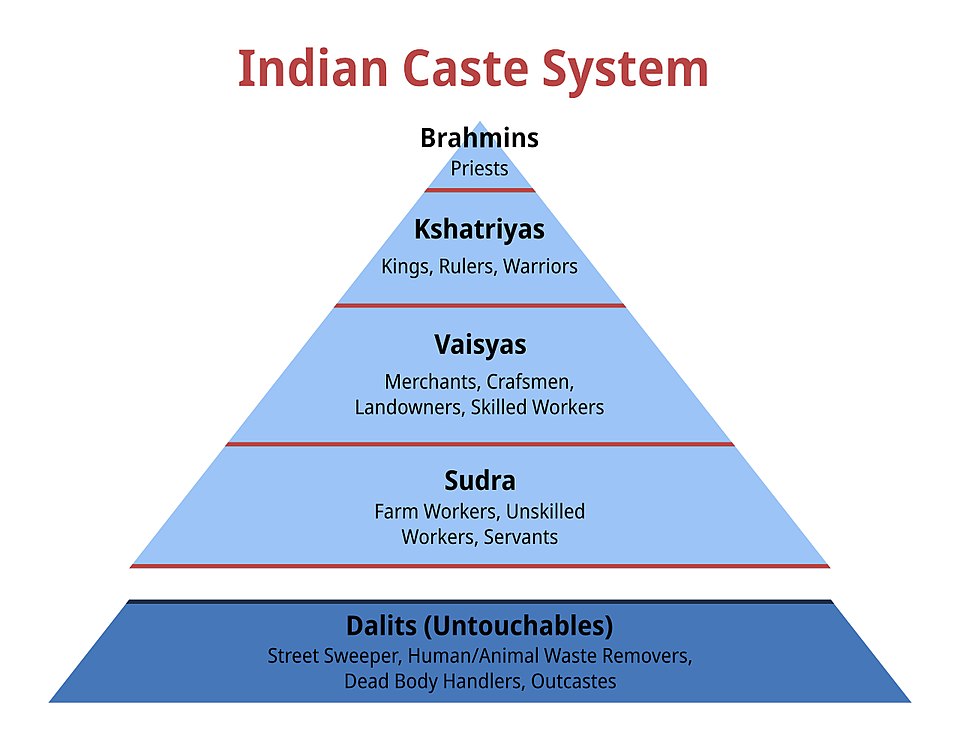
- Brahmins also includes teachers
- Asura: "power-seeking beings related to the more benevolent Devas in Hinduism"
- In Buddhism, "The asura realm is one of the realms in which one can be reborn as a result of experiencing the fruits of wholesome karma, while engaging in unwholesome karma."
- "According to the Bhagavad Gita (16.6-16.7), all beings in the universe have both the divine qualities (daivi sampad) and the demonic qualities (asuri sampad) within each. The sixteenth chapter of the Bhagavad Gita states that pure god-like saints are rare and pure demon-like evil are rare among human beings, and the bulk of humanity is multi-charactered with a few or many faults. According to Jeaneane Fowler, the Gita states that desires, aversions, greed, needs, emotions in various forms "are facets of ordinary lives", and it is only when they turn to lust, hate, cravings, arrogance, conceit, anger, harshness, hypocrisy, cruelty and such negativity- and destruction-inclined that natural human inclinations metamorphose into something demonic (Asura)."
- Rajasuya sacrifice: "The rajasuya is associated with the consecration of a king and is prescribed as a ritual to establish a king's sovereignty."
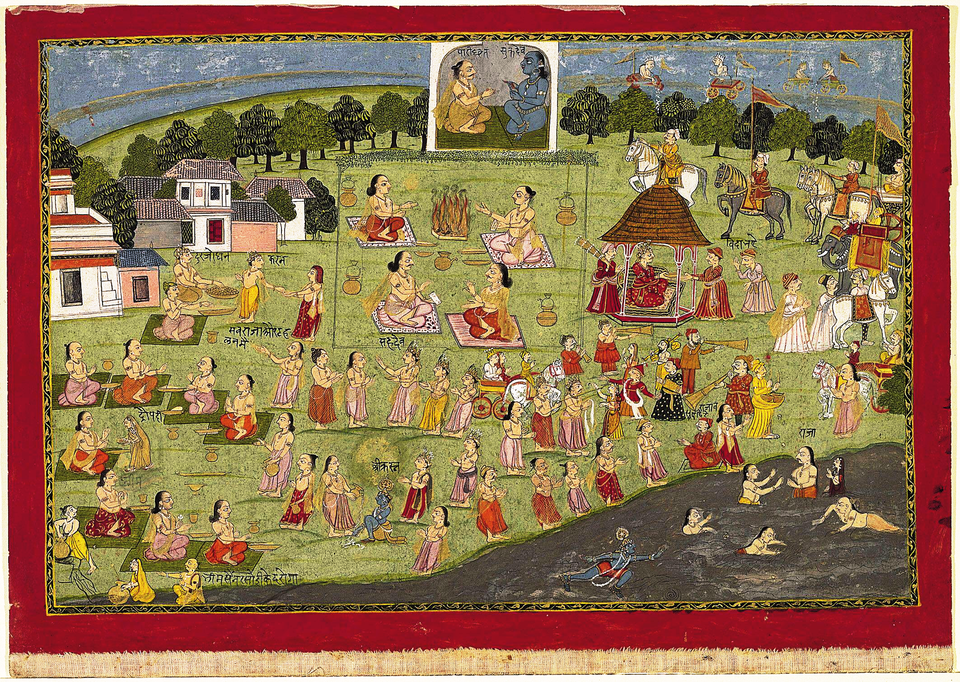
- Danavas: "a mythological race of asuras, the half-brothers to the devas and daityas that are found in a range of Hindu texts. The danavas are a part of a larger group of the asuras, and are typically portrayed as opposed to the Hindu deities."
- Kali: "also called Kalika, is a major goddess in Hinduism, primarily associated with time, death and destruction"
- Ghandara: "a member of a class of celestial beings in Indian religions, such as Hinduism, Buddhism, and Jainism, whose males are divine performers such as musicians and singers, and the females are divine dancers. In Hinduism, they are regarded to be the celestial demigods who serve as the musicians of the devas."
- World guardian gods
- Indra
- Yama
- Varuna
- Agni
- Nara-Narayana
- Diadem: "A diadem is an ornamental headband worn by monarchs and others as a badge of royalty. It can also be a jewelled ornament in the shape of a half crown, worn by women, or a wreath worn around the head."
- Moksha: "Moksha has been defined not merely as absence of suffering and release from bondage to saṃsāra. Various schools of Hinduism also explain the concept as presence of the state of paripurna-brahmanubhava (the experience of oneness with Brahman, the One Supreme Self), a state of knowledge, peace and bliss."
related art
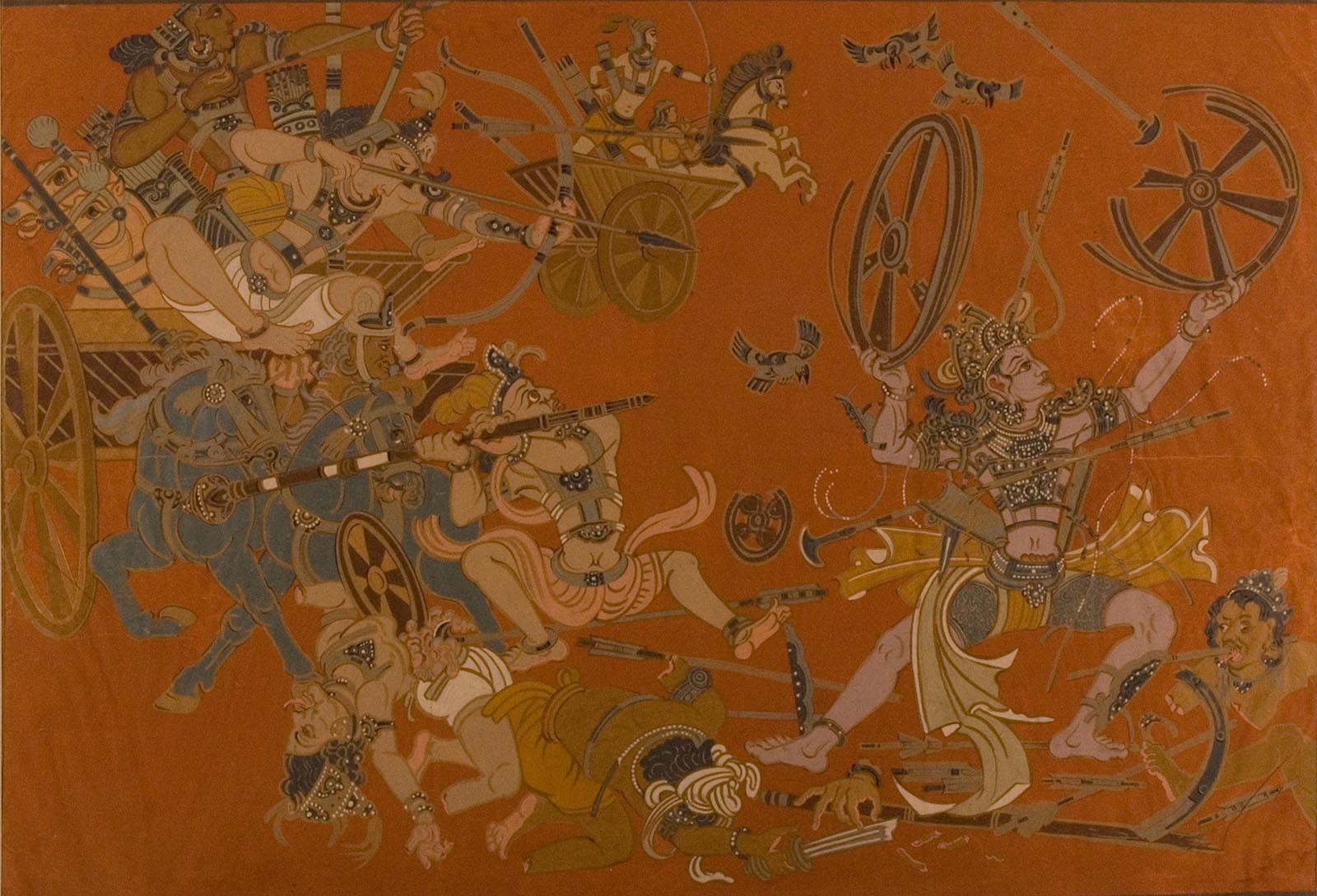
Abhimanue Badh by Nandalal Bose (1882–1966)
related
highlights
Page numbers from KoReader on an epub version. There are a total of 1748 pages.
This is the tale of a tragic dynasty;
a narrative of hatred, honor, courage,
of virtue, love, ideals and wickedness,
and of a war so terrible, it marked
the threshold between one age and the next.
(74)
Note: 1
Although the poem tells of huge events,
battles, armies of a million men,
and though it speaks of gods and demons acting
directly in the human world, the gist—
the conflicts and dilemmas, the regrets
the way that good and bad, wisdom, delusion,
strive for dominance in each of us —
is still played out in every human heart
and always will be.
(81)
Note: 3(Dharma), Epic poetry reflects the divinity within the human psyche
He himself
was both author and actor in his story—
as we are in our own lives and, besides,
all is permitted to the storyteller.
(89)
Note: Stories are powerful
The poem was a map of the labyrinth,
the moral maze, that is our life on earth.
It told of choices and of mortal error,
of how even the saintly go astray
while, even in the worst, glimmers of gold
reveal themselves to a compassionate eye.
(89)
Note: 4
Thought became language — that was the alchemy
that led in turn to deeds.
(144)
Note: this is a really pretty phrase
Now he had understood
what it means to aim, but without straining.
He had a glimpse of how one may become
a channel for the world's natural forces
to play themselves out. How, without striving,
without attachment to the end result,
abandoning desire and memory,
an arrow can be loosed, and find its home.
(168)
Note: 無為, to navigate life as water does the stream.
[The Master] has without possessing,
and acts without any expectations.
When her work is done, she takes no credit.
That is why it will last forever.
The Dao De Jing 道德經
Desire points to the future, memory the past. Thus to take aim without straining can only happen in the now. Only an arrow loosed within this pocket of time can effortlessly find its home.
The most powerful forces in the world
are often born in darkness. Think of fire,
the molten fire that sleeps beneath the ocean
but will erupt at the apocalypse
to engulf the earth. The mightiest rivers
have unimpressive origins; their greatness
grows as they make their journey through the world
joining with others, broadening, deepening,
meeting barriers, overcoming them.
That's how it is with the noblest warriors.
(218)
Note: 7
The Kauravas were routed. They had learned
that a thirst for victory was not enough.
(223)
Note: 3(Character) patience in war and in life
"So, you see," said Vyasa to Drupada,
"what seems to you contrary to dharma
is, in fact, celestially ordained."
(299)
Note: celestial vs. human law, cf. Antigone
The air was still and heavy
with expectation, earth begging for rain
as though the whole of life were in suspense.
(332)
Note: 457 this scene is so picturesque!! Beautiful!!
Maya, a gifted demon, dodging the flames,
about to be cut down by Krishna's discus,
cried out, "Arjuna! Save me, Arjuna!"
Appealed to in this way, Arjuna called,
"Have no fear." And Maya was protected.
Note: speaks to Arjuna's ego
As his boon, Krishna asked that Arjuna
should be his friend lifelong, both in this world,
and in world's to come.
Note: 3(Friendship) similar to friendships in Greek epics
"Yudhishthira," said Krishna with a smile,
"time flows on, day by day, and waits for no one.
We do not know when we will meet our death.
To hesitate, to turn away from dharma,
never prolongs life. But it costs a man
his honor—and that loss is worse than death.
Do not divide your mind against itself
through doubt and paralyzing cogitation.
The great man acts, as time demands of him."
(371)
Note: 57 he's spitting bars holyyy
We behold in Krishna
the source of everything that's valuable.
As Mount Meru is the greatest mountain,
as the eagle is the lord of birds,
as the ocean is deepest among waters,
so is Krishna foremost among beings
ina all the worlds, past, present and to come.
Good people everywhere pay tribute to him.
Contained within him is the universe,
its origins, its being and its end.
(389)
Discontent and jealousy are good
for a kshatriya. Contentment weakens
the ambitious striving which can bring success;
so does fear, and so does limp compassion.
In pursuit of prosperity, any means,
any means at all, are justified.
Think of Indra, who cut off Namuchi's head
even though he had promised not to kill him.
An enemy is onee whose interests,
like the Pandavas', run counter to one's own.
Peaceful coexistence with an enemy
is the way of fools and cowards.
(413)
Note: 3(Honor, character) contrasting with Yudhishthira's philosophy. Ego-centric versus an honorable king's outlook.
But what man is there who is not
subject to the blinding power of fate
that dazzles us, depriving us of reason?
What will happen is what time ordains.
(417)
Note: 3(Fate)
"It is the work of fate," sighed Dhritarashtra.
"I always try to make the best decisions,
but when the gods intend someone's defeat
they first make him mad, so that the wrong course
seems to him the right one. The power of fate
can be simply this twisted view of things.
All else follows . . .
Yet my foolishness,
my great love for my son, will bring about
the all-consuming tragedy of war."
(462)
Note: 3(Dharma, fate) Dhritarashtra passively accepts fate, whereas the Pandavas struggle between upholding their honor and attempting to defy it. Ironically, Dhritarashtra has the power to determine the fate of the nation when Durodhyana is born, yet in his weakness, he is unable to make a decision for the greater good. However, his dilemma is also a very human dilemma, and he suffers seeing the consequences of his actions unfold—this is his karma.
They have their gaze fixed on eternity
and that helps me achieve a kind of peace
when otherwise I would be overwhelmed
by grief and guilt.
(491)
Note: 3(Ego)
"But Draupadi,
as the wise know, sinful acts arise
from overhasty rushing to revenge.
One who is wronged and who responds with anger
is prone to bad judgment, liable to act
impulsively. Good rarely comes of it.
If every person with a sense of grievance
struck back immediately, where would it end?
Unceasing death inflicted, death returned.
An endless round of blow and counter-blow
allows for no reflection or repentance
and only leads to sorrow upon sorrow.
A peaceful world is founded upon patience
and only when a kingdom is at peace
can children flourish, cows grow fat, and farmers
plant seeds with confidence, watch their crops grow,
and gather a rich harvest. "I believe
that forbearance is the strength of the strong.
One who is forbearing retains power.
Anger is not strength but, rather, weakness;
is is not the same as authority . . . "
(492)
Note: 3(Ego)
The Almighty is not like a loving parent
but, like a child playing with its toys,
manipulates our limbs, controls the strings
as though we were wooden puppets. I believe
there's no such thing as freedom, no mastery
over ourselves or anybody else.
(494)
Note: 3(Fate) Draupadi's perspective after being utterly humiliated—understandable. What does the Almighty refer to? Dharma?
I choose to follow dharma, and I do it
because it is right, not to obtain rewards.
(494)
Note: 3(Character, dharma)
I don't despise dharma.
But one who does nothing in the face of evil
Is an unfired pot, worn away by water.
You preach forbearance above everything,
but every living human being must act.
From the infant, sucking it mother's nipple,
to the dying person's final labored breath,
we fight to stay alive. What we achieve
is not just fate, nor is it mere chance
but the fruit of all we try to do.
We have to strive with what strength we possess,
using reason and determination,
to convert our actions to achievement.
That way, we do not need not reproach ourselves.
A peasant from the soil and plants the seed.
Then he waits for rain. If the monsoon fails,
and the seedlings with the ground,
he will, at least, have acted as he should.
Without faith and chance he cannot prosper.
But without his action, best of husbands,
fate, and chance have nothing to work upon.
(496)
Note: 3(Character, fate) a sound argument against Yudhishthira's inaction by Draupadi. However, inaction in some cases is also action. By sticking to his principles, Yudhishthira upholds dharma, which is action in itself. Rather than acting hastily, he bides his time with patience to reap results tenfold.
If you take the long view
the wicked do not flourish. They are like plants
with showy flowers but weak and shallow roots.
The virtuous are well grounded in dharma
and, through devoted discipline, they weather
bad times and good, seeing them as the same.
Like the demons before them, wicked people
lose direction, and fall prey to discord.
Given to restless searching after pleasure,
true and lasting happiness eludes them.
(534)
Note: 3(Character)
'I am Narayana,' replied the child,
'creator and destroyer of all creatures.
I am Vishnu, Shiva, Yama and all gods.
I am the Placer; I am the Sacrifice.
To sustain the earth, I manifest
at different times as different incarnations;
I take on human form to combat evil
but no one knows me. Understand, brahmin,
that every human quality and impulse—
anger, lust, fear, joy, confusion
as well as duty, truthfulness, compassion—
is an aspect of me. Human beings act
not from free will, but influenced by me.
I alone control the wheel of time.
At the end of each cycle of ages
I am all-destroying Time itself.'
(577)
To be happy,
one has to suffer first. Each of these states
is simply how things are. The two conditions
succeed each other as the seasons do.
The wheel turns.
(601)
'There are some things in life,' Savitri said, 'that only happen once. I have chosen my husband, and I will not choose a second time.'
(613)